
Many of us take notes. During lectures, meetings, or while studying—we write, type, or highlight. Yet it often happens that when we look back at our notes later, they’re of little help. The words are there, but there’s no real understanding behind them.
The problem isn’t that we take notes. It’s what we use the notes for.
In many cases, note-taking is mere recording: we try to write down as accurately as possible what is being said. This works particularly well on digital devices, where we can follow the information almost word for word. But that alone doesn’t make the notes useful. A good note doesn’t just repeat the material; it helps us interpret it.
Notes as a Space for Thinking
It’s worth thinking of notes not as a copy, but as a kind of space—a surface where our emphases, connections, and our own thoughts become visible.
When we take notes by hand, this begins to take shape almost on its own. We can’t write everything down, so we abbreviate, highlight, and rearrange. An arrow, a drawing, or an additional comment appears next to a thought. Paper doesn’t force linear progression, so we naturally begin to “think in space” within it.
This is the point where the note no longer merely records, but supports thinking.
Why does it work differently by hand?
One of the greatest advantages of handwriting is precisely that it is imperfect and non-linear. This may seem like a disadvantage at first, but in fact, this is what gives it its power.
It’s much easier to do by hand:
- we draw arrows between ideas
- we highlight sections visually
- we draw simple diagrams
- we group related elements together
These may seem like small details, but what happens is that our thinking becomes visible. We don’t just write down information; we begin to organize it.
Linear and Spatial Note-Taking
Digital note-taking is essentially linear: we move in lines, create lists, and information follows one after another. This is fast and orderly, but it reflects relationships less clearly.
Handwritten notes, on the other hand, are spatial. Within a single page, we see the emphasis, the connections, and the highlights. We see not only what is included, but also how the parts relate to one another.
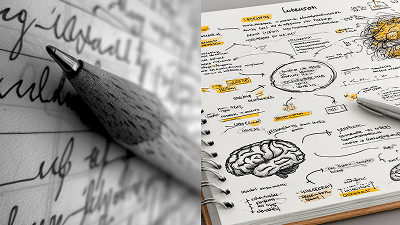
This difference also matters during recall. Many times, we do not remember things word for word, but visually: “it was somewhere at the top of the page,” or “there was a highlighted section on the right.” Handwriting supports this type of memory.
Methods That Work Especially Well by Hand
One advantage of handwriting is that it supports different note-taking styles, depending on how we think.
- Structured Notes (Cornell Method)
With a simple layout (notes – keywords – summary), it helps organize information and makes revision easier later. - Visual Note-Taking
We use not only text, but also drawings, icons, and arrows. This is especially useful when trying to understand complex topics. - Mind Maps
Starting from one central concept, we build out the entire topic. This helps reveal connections and see the bigger picture.
What matters is not which method we use, but whether the notes reflect the way we think.
The Most Common Mistake
Most notes fail because they are too detailed. They are filled with sentences, but lack real structure.
What is missing: hierarchy, emphasis, and connections.
Notes like these are more like plain text than a useful tool. They are difficult to review and do not support thinking.
Good notes are not good because they contain everything, but because they are clear and usable.
How to Take Better Notes
You do not need to create a completely new system — it is enough to become more intentional about a few things.
It is worth:
- not writing things down word for word, but rephrasing them
- leaving space on the page instead of filling every inch
- highlighting key points
- organizing information visually
- connecting related ideas
The goal is not to create “beautiful notes,” but to make sure that when you look back at them, they help you think about the topic again.
Handwriting and Digital Notes Together
The most effective approach is often not about choosing one or the other.
Digital tools are ideal for quickly collecting and organizing information. Handwriting, however, is strongest when it comes to processing and understanding that information.
The two work best together:
- collect information digitally
- process and reflect on it by hand
Conclusion
Handwriting in note-taking is not just a technique, but a different way of thinking.
It helps us not only record information, but interpret it; not only think in lines, but in connections; and turn notes into a truly useful tool.
The real question is not whether you take notes, but whether your notes help you think.
This is where handwriting offers a real advantage: it does not simply preserve information, but gives shape to the way you understand it.